Daily with | 08:00 - 20:00


Find

Contact us

Kyiv
st. Garmatnaya, 3
 Мережа СТО в місті

Kyiv
st. Garmatnaya, 3
 Мережа СТО в місті

 Години роботи
 Daily with
08:00 - 20:00
Air Conditioner Pipe Freezing in a Car: Finding the Causes of Thermal Regulation Failure
On a hot day, the driver turns on the climate control, but instead of stable cooling encounters a strange problem: the airflow from the vents gradually weakens, while frost or even a layer of ice appears on the air conditioning pipes under the hood. At first glance, it may seem that the system is simply cooling too efficiently, but in reality, this situation indicates a malfunction in the normal operating mode.
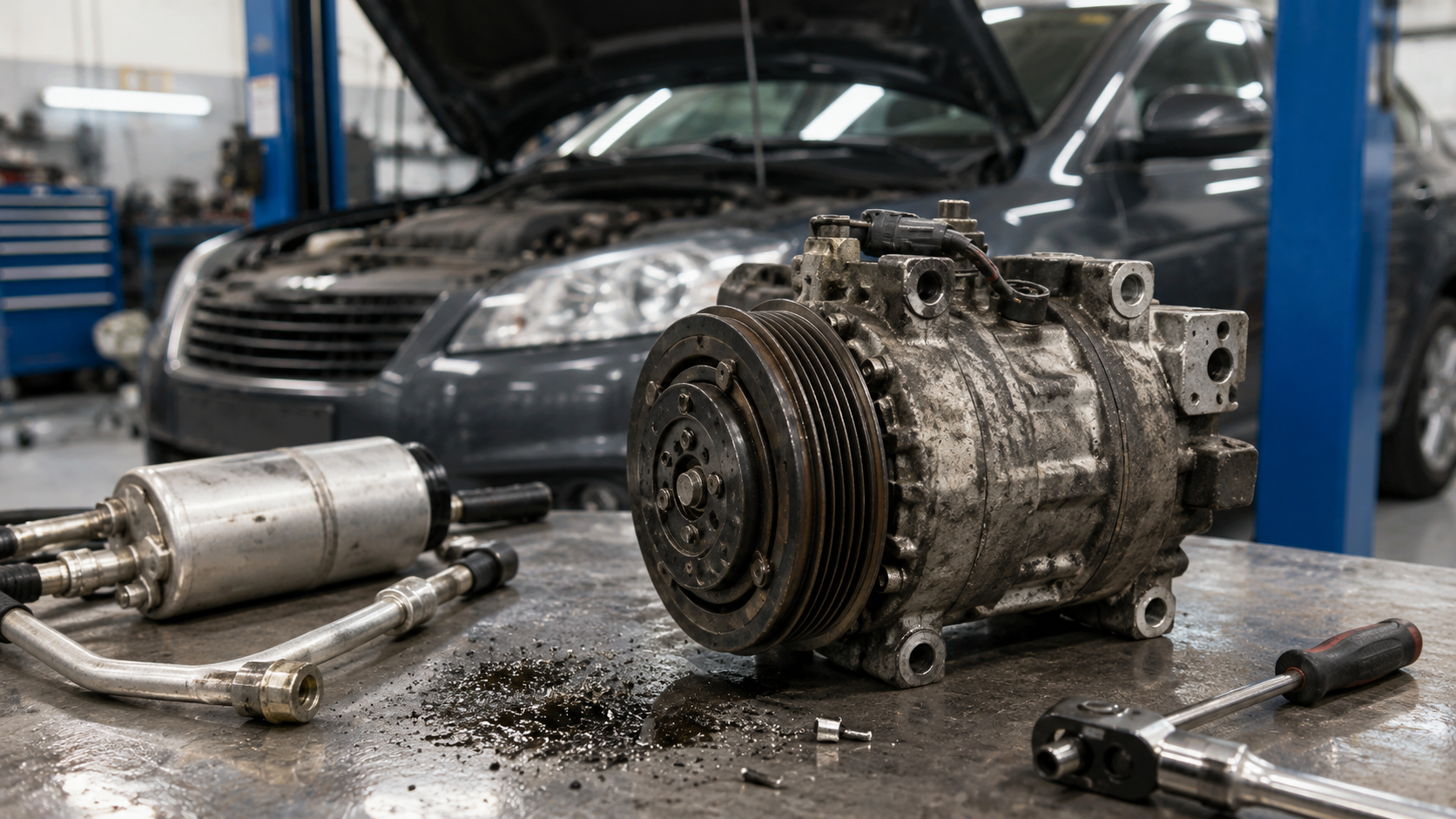
If an air conditioner pipe freezes in a car, it almost always indicates a malfunction of one or more components of the system. Ignoring the problem can lead not only to reduced cooling efficiency but also to expensive compressor repairs.
Why Moisture Freezes on the Pipes
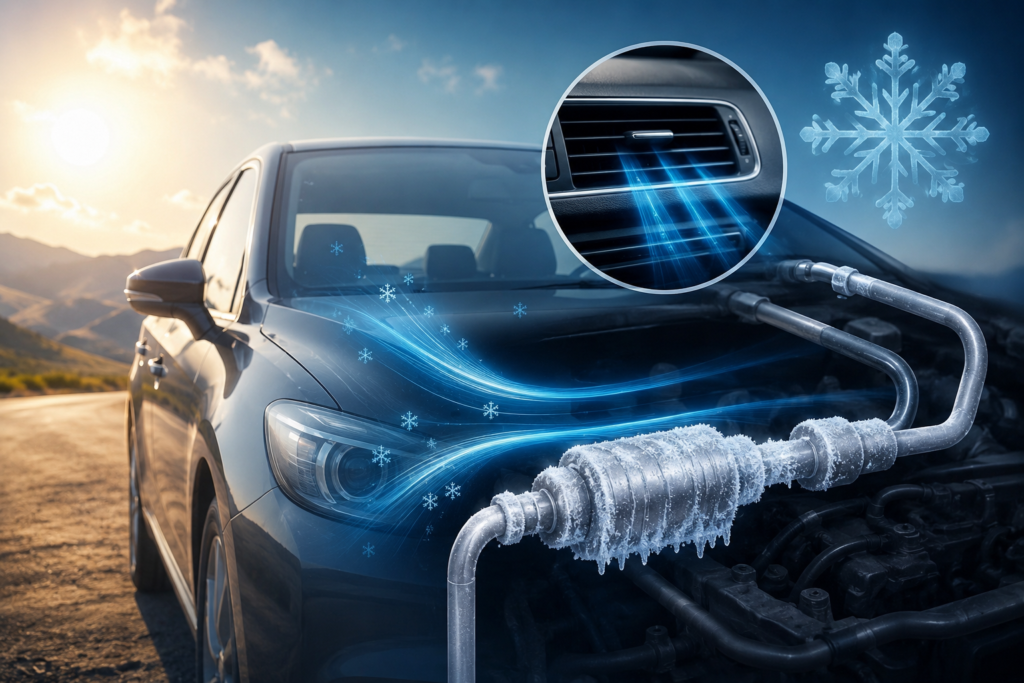
To understand why icing occurs, it is necessary to understand how an automotive air conditioning system works.
The refrigerant circulates through a closed circuit, continuously changing its pressure and temperature. After passing through the thermostatic expansion valve (TXV), its pressure drops sharply, causing its temperature to decrease. This is what allows the evaporator to cool the air entering the passenger compartment.
The lower the system pressure becomes, the lower the refrigerant’s boiling point. If the surface temperature of the pipe or evaporator drops below 0°C (32°F), moisture condensed from the air begins to freeze. At first, a thin layer of frost appears, which gradually develops into solid ice.
Under normal operating conditions, the system maintains a balance between cooling and the heat transferred to the evaporator by the cabin airflow. If this balance is disturbed, a characteristic white frost forms on the low-pressure line.
Low Refrigerant Charge: A Common Cause of Icing
Many drivers are surprised to learn that a refrigerant shortage can actually cause the system to freeze.
It seems logical to assume that less refrigerant should simply result in less cooling. In reality, a refrigerant leak changes the operating pressure inside the circuit. Because of the excessive pressure drop, the temperature in certain sections of the system becomes too low, leading to ice formation.
That is why the question, “Why does my car air conditioner freeze up?” often begins with checking the system for leaks and verifying the refrigerant charge.
Insufficient Airflow
Even if the refrigeration circuit itself is operating properly, icing may occur due to insufficient airflow passing through the evaporator.
The most common causes include:
- a clogged cabin air filter;
- a dirty evaporator;
- a faulty blower fan;
- malfunctioning climate control air doors.
If airflow through the evaporator becomes insufficient, heat can no longer be removed effectively from its surface. As a result, the temperature drops sharply and moisture condensation turns into ice.
Typical signs of a clogged air conditioner evaporator include weak airflow even at the highest blower speed, increased cabin humidity, and gradually declining cooling performance during long trips.
The cabin air filter also deserves special attention. Heavy contamination significantly restricts airflow.
Signs of a clogged cabin air filter include:
- weak airflow from the vents;
- frequent windshield fogging;
- unpleasant odors inside the cabin;
- increased blower fan noise;
- a tendency for the system to freeze.
Thermostatic Expansion Valve Malfunctions
Another important component of the system is the thermostatic expansion valve (TXV).
Its purpose is to precisely regulate the amount of refrigerant entering the evaporator. The stable temperature operation of the entire air conditioning system depends on the proper functioning of this component.
Typical symptoms of a faulty TXV include:
- unstable cooling performance;
- sudden temperature fluctuations;
- ice formation on the pipes;
- abnormal pressure readings;
- intermittent compressor shutdowns.
If the vehicle’s thermostatic expansion valve malfunctions, refrigerant flow becomes uncontrolled. As a result, parts of the system become excessively cold, causing ice formation.
The Role of Sensors and Electronics
In modern vehicles, the climate control system is managed by electronic controls.
To protect the system from freezing, an evaporator temperature sensor continuously monitors the evaporator temperature. If the temperature approaches a critical level, the control module changes the compressor operating mode.
If the sensor malfunctions or transmits incorrect readings, the system may fail to respond to dangerously low temperatures, creating conditions that allow ice to form.
Why Icing Is Dangerous for the Compressor
Ice forming on the pipes is far more than just a cosmetic issue.
During prolonged operation under abnormal conditions, the refrigerant no longer evaporates properly. Some of the refrigerant may remain in liquid form where only vapor should be circulating.
The compressor is designed to compress refrigerant gas. If liquid refrigerant enters the compressor because of improper system operation, a phenomenon similar to hydraulic lock occurs. This dramatically increases the load on the valves, pistons, and other internal components.
As a result, compressor seizure or premature compressor failure often begins with prolonged neglect of system icing.
Top popular news
- Car Interior Detailing: When a Vacuum Cleaner Is No Longer Enough
- Electric Vehicle Brake Pads: Longer Service Life with a Hidden Risk
- LED Instead of Halogen in a Factory Headlight: Why a Simple Replacement Does Not Work
- LPG Tank Inspection: Service Life and Safe Operation
- How Many Times Can You Polish a Car Body: What Determines the Service Life of the Clear Coat
- Paintless Dent Repair: Which Defects Are Suitable for PDR
- Installing LPG on a new car: not every engine works equally well on gas
- Seasonal tyre changes: more than simply swapping wheels

Subscribe to our newsletter!
To stay updated with the latest news
Related services


Book a service