Daily with | 08:00 - 20:00


Find

Contact us

Kyiv
st. Garmatnaya, 3
 Мережа СТО в місті

Kyiv
st. Garmatnaya, 3
 Мережа СТО в місті

 Години роботи
 Daily with
08:00 - 20:00
Symptoms of a Clogged Fuel Filter: How to Protect Fuel Injectors from Dirt, Water, and Poor-Quality Fuel
Modern engines have become significantly more demanding when it comes to fuel quality. This is especially true for engines equipped with direct fuel injection systems such as FSI and GDI, where fuel injectors operate under extremely high pressure and fuel metering accuracy is measured in fractions of a millimeter. Even tiny mechanical contaminants or droplets of water can affect engine stability and accelerate the wear of expensive fuel system components.
The fuel filter serves as the primary protective barrier between the fuel tank and the fuel injection system. Its purpose is to trap dirt, corrosion particles, water, and other contaminants before they reach the fuel pump and injectors.
Why Fuel Cleanliness Is So Important
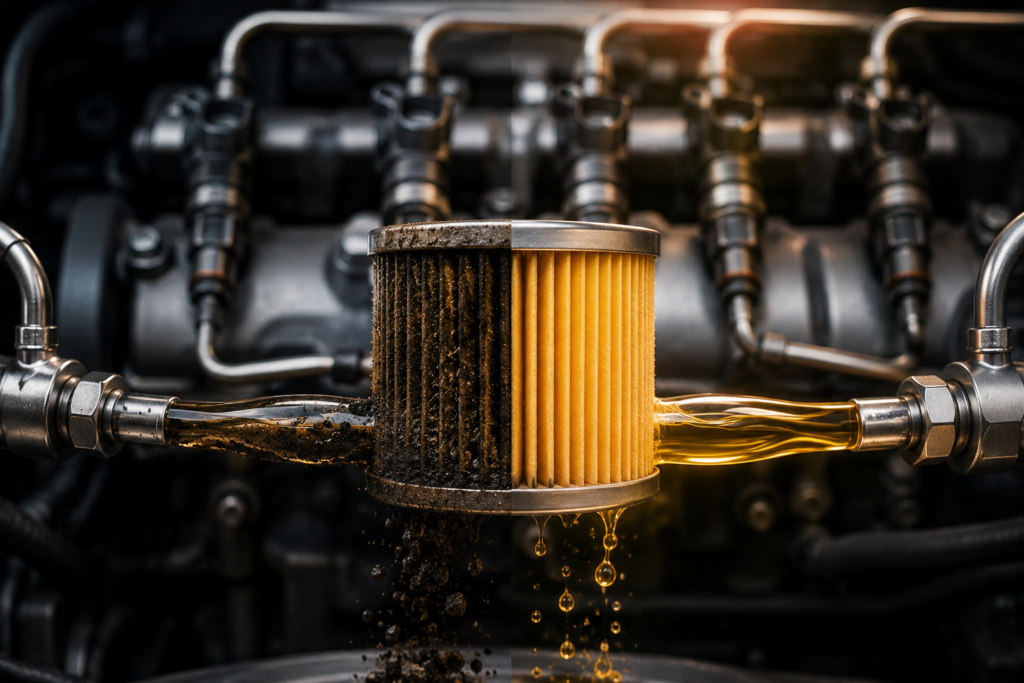
Fuel travels a long way from the refinery to the vehicle’s fuel tank. During transportation and storage, it can become contaminated with dust, rust, condensation, and various mechanical impurities.
Direct injection systems are particularly sensitive to such contamination. In FSI and GDI engines, the injectors have extremely narrow spray channels. Even a tiny particle of dirt can alter the shape of the fuel spray pattern, affecting air-fuel mixture formation, engine performance, and fuel consumption.
That is why modern vehicles require efficient multi-stage fuel filtration.
What the Fuel Filter Does
The fuel filter performs several important functions simultaneously:
- traps mechanical contaminants;
- protects fuel injectors from contamination;
- maintains the required fuel flow capacity;
- helps separate water from the fuel;
- reduces the load on the fuel pump;
- protects fuel system components from premature wear.
In diesel vehicles, an additional water separator is used to collect moisture and prevent it from entering the injection system.
Where the Fuel Filter Is Located
Depending on the vehicle design, the fuel filter may be located:
- inside the fuel tank as part of the fuel pump module;
- underneath the vehicle;
- inside the engine compartment;
- as part of a combined fuel filtration system.
For this reason, maintenance schedules may differ even between different models from the same manufacturer.
Symptoms of a Clogged Fuel Filter
During normal operation, the filter element gradually accumulates contaminants. As a result, its flow capacity decreases, causing fuel pressure to drop.
The most common symptoms of a clogged fuel filter include:
- loss of power during acceleration;
- sluggish throttle response;
- hesitation during acceleration;
- unstable engine operation under load;
- difficult starting after prolonged parking;
- intermittent engine stalling;
- loss of power at high RPM;
- jerking while driving uphill.
The problem becomes especially noticeable when the engine requires maximum fuel delivery. If the filter is clogged, the system simply cannot supply the amount of fuel the engine needs.
How a Dirty Fuel Filter Affects Fuel Pressure
For proper engine operation, stable fuel pressure must be maintained throughout the fuel system.
When the fuel filter becomes clogged, the fuel pump has to work under increased load. Despite this, less fuel than required reaches the fuel rail.
As a result, the following problems may occur:
- a lean air-fuel mixture;
- injector performance interruptions;
- unstable idle speed;
- reduced engine performance;
- increased load on the fuel pump.
In modern vehicles, the engine control unit may also store fault codes related to insufficient fuel pressure.
Why Water Is Especially Dangerous
Many drivers underestimate the dangers of moisture inside the fuel system.
Even a small amount of water can cause:
- corrosion of metal components;
- reduced lubrication of moving parts;
- accelerated fuel pump wear;
- injector damage;
- damage to the high-pressure fuel pump plunger assembly.
This issue is especially critical for diesel engines. That is why the water separator and timely fuel filter replacement are essential for protecting the entire fuel injection system.
Why Diesel Engines Are More Sensitive
In Common Rail diesel systems, fuel performs two functions simultaneously it delivers energy and lubricates the fuel system components.
The high-pressure fuel pump plungers and injectors operate with extremely tight tolerances. Any contamination or moisture can significantly accelerate their wear.
Another challenge during winter is diesel fuel waxing. If the filter is already partially clogged, wax crystal formation further reduces its flow capacity.
For this reason, replacing the diesel fuel filter is one of the most important maintenance procedures.
Which Components Are Damaged by Delayed Fuel Filter Replacement
Operating a vehicle with a contaminated fuel filter gradually affects the entire fuel delivery system.
The components most at risk include:
- fuel pump;
- fuel injectors;
- fuel rail;
- fuel pressure regulator;
- high-pressure fuel pump;
- high-pressure pump plunger assemblies.
Repairing these components often costs many times more than replacing the fuel filter.
How Often Should the Fuel Filter Be Replaced?
One of the most common questions among vehicle owners is how often the fuel filter should be replaced.
The exact replacement interval depends on the manufacturer’s recommendations, engine type, and operating conditions. Fuel quality also has a significant impact.
It is not advisable to wait until the engine starts stalling or refuses to start. Reduced filter flow capacity begins damaging the fuel system long before obvious symptoms appear.
Many drivers ask about the cost of fuel filter replacement, but this maintenance procedure is always far less expensive than repairing the fuel system or rebuilding injectors and the high-pressure fuel pump.
Practical Example
The owner of a diesel crossover complained about reduced power during overtaking and intermittent hesitation under load. Diagnostics revealed low fuel pressure and a heavily contaminated fuel filter.
After removing the filter, technicians also found a significant amount of water accumulated inside the separator bowl. Once the filter was replaced, the fuel system was cleaned, and the moisture was removed, engine performance returned to normal and fuel pressure was fully restored.
Conclusion
The fuel filter is one of the most important protective components in a modern engine. It traps mechanical contaminants, helps separate water from the fuel, and maintains stable fuel pressure throughout the system.
The appearance of hesitation, power loss, difficult starting, and other symptoms of a clogged fuel filter indicates that the fuel system should be inspected. Delaying filter replacement can lead to fuel starvation, excessive fuel pump load, and accelerated injector wear.
Regular maintenance helps preserve the service life of the fuel system and prevents significantly more expensive repairs in the future.
Top popular news
- Electric Vehicle Suspension: What Makes It Different?
- Electric Vehicle Maintenance Schedule: What Needs to Be Replaced?
- Wheel Alignment: After Which Repairs Is It Mandatory?
- Suspension Knocking Over Bumps: How to Tell the Difference Between a Sway Bar Link and a Shock Absorber
- Steering Wheel Play: When to Replace Tie Rods and Tie Rod Ends
- Power Steering Makes Noise or Feels Heavy: Causes and Diagnosis
- DSG Mechatronic Unit: Early Signs of Failure and Why Ignoring the Problem Costs More
- Automatic Transmission Jerks During Shifting: How to Tell Normal Operation from a Fault

Subscribe to our newsletter!
To stay updated with the latest news
Related services


Book a service