Daily with | 08:00 - 20:00


Find

Contact us

Kyiv
st. Garmatnaya, 3
 Мережа СТО в місті

Kyiv
st. Garmatnaya, 3
 Мережа СТО в місті

 Години роботи
 Daily with
08:00 - 20:00
Charging an electric car at home: requirements to consider before buying
An electric car is often purchased with convenient home charging in mind. However, after the first connection, owners sometimes discover that old wiring, sockets, or protective devices are not designed for a load lasting many hours. This is why the basic requirements for charging an electric car at home should be considered before choosing the vehicle. They concern the condition of the home electrical system, the way the charging equipment is connected, and correct load distribution.
A standard household socket is not suitable in every case
One of the most common questions from prospective owners is whether an electric car can be charged from a standard household socket. Technically it can, but without first assessing the condition of the electrical system, this option is not always safe.
Household appliances usually operate for relatively short periods, whereas an EV charger may draw power continuously throughout the night. Under these conditions, even minor problems with old contacts, worn sockets, or cabling become apparent much more quickly.
Even an electrical system that has worked reliably with household appliances for years may not be ready for the prolonged load created by EV charging. Once an electric car is purchased, the owner begins charging it regularly at night, and after some time the socket may start to heat up while the circuit breaker trips periodically. The problem is not the vehicle itself but the fact that the electrical circuit was never designed for a continuous load lasting many hours.
How a Wallbox differs from charging through a household socket
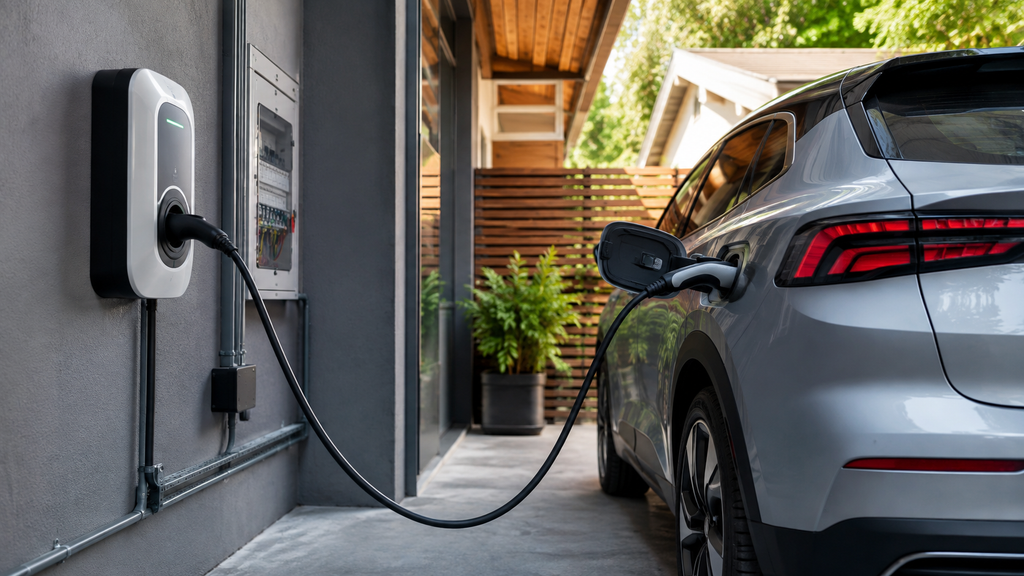
When charging from a standard socket, the load passes through the home’s existing wiring. A Wallbox is connected to a dedicated electrical circuit and continuously manages the charging process while communicating with the vehicle.
Compared with a standard socket, a charging station offers several important advantages:
- stable control of charging power in kW;
- a higher level of electrical safety;
- faster battery charging;
- support for a modern Type 2 charging cable;
- correct operation with both single-phase and three-phase supplies.
When planning the installation of a Wallbox charging station, owners are usually interested in the price of installation. It depends not only on the equipment model, but also on the condition of the home’s electrical system, the length of the new circuit, and the complexity of the electrical work.
What to check before connecting an electric car
The condition of the home electrical system determines not only charging speed but also the safety of daily use. In many homes, wiring was installed decades ago, when a continuous load of this level was simply not anticipated.
Before installation, it is advisable to check:
- the cable material and cross-section;
- the condition of contacts in the distribution board;
- the maximum permitted incoming load;
- whether the supply is single-phase or three-phase;
- what wiring capacity is required for charging the vehicle.
Another typical situation occurs in the evening when a water heater, air conditioner, hob, and other high-power appliances are operating at the same time. If the electric car is connected to the same socket group, the combined load may exceed the capacity of the circuit. As a result, the circuit breaker trips regularly even though each device works correctly on its own.
A dedicated circuit and protection reduce the risk of overload
For regular charging, it is advisable to use a dedicated electrical circuit run directly from the distribution board. This isolates the charging load from other household consumers and makes system monitoring easier.
A suitable protective circuit breaker designed for EV charging is selected for this line according to the supply parameters, charger power, and manufacturer requirements. Additional residual-current protection devices are installed when required.
Extension leads and multi-plug adapters are not recommended for regular charging. Every additional contact connection creates extra resistance, and under prolonged load this increases the risk of overheating contacts and damaging insulation.
What affects charging time
It is impossible to determine exactly how long an electric car takes to charge at home without considering the vehicle’s specifications. Charging time depends on traction-battery capacity, the initial state of charge, the maximum accepted charging power, the capabilities of the charging equipment, and the characteristics of the home electrical supply.
With the same battery, a vehicle may charge at different speeds depending on how it is connected. A Wallbox makes more effective use of the EV’s charging capabilities, while a three-phase supply, where available, can provide more power than a single-phase connection.
Checking the home electrical system before buying an electric car costs far less than replacing wiring later after repeated overloads, overheated contacts, or frequent operation of protective devices.
Top popular news
- Car Interior Detailing: When a Vacuum Cleaner Is No Longer Enough
- Electric Vehicle Brake Pads: Longer Service Life with a Hidden Risk
- LED Instead of Halogen in a Factory Headlight: Why a Simple Replacement Does Not Work
- LPG Tank Inspection: Service Life and Safe Operation
- How Many Times Can You Polish a Car Body: What Determines the Service Life of the Clear Coat
- Paintless Dent Repair: Which Defects Are Suitable for PDR
- Installing LPG on a new car: not every engine works equally well on gas
- Seasonal tyre changes: more than simply swapping wheels

Subscribe to our newsletter!
To stay updated with the latest news
Related services


Book a service